Introduction
Staff are stretched thin. Manual processes eat hours that teams don't have. Decisions get made on last quarter's data because no one has time to pull current numbers. For nonprofits, associations, and small businesses, these aren't abstract problems — they're daily operational realities.
AI business solutions have moved well past the experimental stage. Organizations of all sizes are now using machine learning, automation, and predictive analytics to handle work that previously demanded significant staff time, reduce costly errors, and make faster decisions with better information.
This article covers:
- What AI business solutions actually are
- How they're reshaping core business functions
- The real benefits organizations are seeing
- Challenges worth planning for
- How to start adopting AI in a practical, governed way — without needing an enterprise IT department to pull it off
Key Takeaways
- AI enhances human judgment by handling high-volume, repetitive tasks without replacing the people doing them
- Data quality is the single biggest factor in whether AI delivers reliable results
- Starting with one high-friction process beats launching a broad AI initiative without a clear target
- Governed adoption with clear policies and defined ownership prevents compliance exposure and data risk
- Smaller organizations benefit most when AI helps them scale capacity without scaling headcount proportionally
What Are AI Business Solutions?
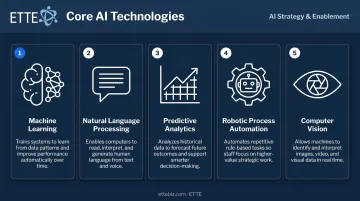
AI business solutions are tools, platforms, and systems that use artificial intelligence technologies to help organizations automate tasks, analyze data, and make smarter operational decisions. The core technologies include:
- Machine learning (ML) — systems that optimize their behavior based on data patterns
- Natural language processing (NLP) — computer processing that understands, interprets, and generates human language
- Predictive analytics — using historical data and pattern recognition to forecast future outcomes
- Robotic process automation (RPA) — software that executes rule-based tasks across applications
- Computer vision — AI that interprets and acts on visual information
AI Augments Human Judgment, Not Replaces It
A common misconception is that AI replaces people. MIT Sloan Management Review research frames it differently: AI is used to "augment decision-making processes," and people can make different choices from identical AI inputs — which means human judgment still drives the outcome.
Consider a practical example: an AI system flags anomalies in a financial dataset within seconds, surfacing the three transactions worth investigating. A staff member still decides what to do about them. The AI handles the volume; the human handles the judgment.
Most organizations don't adopt every AI technology at once. They identify one or two capabilities that address a specific operational need and build from there — a practical starting point for nonprofits and small businesses working within real budget and staffing constraints.
Key Ways AI Is Transforming Business Operations
Automation That Frees Up Staff Time
AI-driven automation is eliminating time-consuming manual tasks across every department — data entry, document processing, invoice management, HR onboarding, and more. A Forrester-commissioned study modeling a 130-employee composite organization — including an education nonprofit — estimated 720 accounts payable hours saved annually just from AI-assisted finance workflows, with total Year 3 savings reaching 8,700 hours across the organization.
Better Decisions from Real-Time Data
AI converts large volumes of raw, unstructured data into actionable insights without waiting for a monthly report cycle. For organizations where leaders must act quickly — boards making budget decisions, executive directors responding to operational shifts — that compression of time matters.
One important caveat: MIT Sloan's demand-forecasting research shows that human oversight remains necessary to contextualize market shifts that AI models haven't encountered before. Algorithmic forecasts miss what isn't in the historical record.
Cybersecurity That Adapts to New Threats
Traditional rule-based security systems respond to known threats. AI-informed security monitors network activity continuously, detects behavioral anomalies, and adapts to new attack patterns — often faster than any manual review process could.
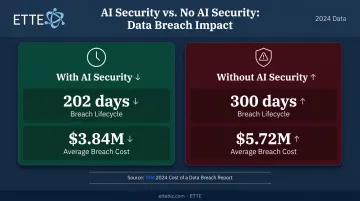
IBM's 2024 Cost of a Data Breach Report, studying 604 breached organizations across 16 countries and 17 industries, found that organizations with extensive security AI and automation averaged a 202-day breach lifecycle versus 300 days for non-users. Average breach costs were $3.84M versus $5.72M. For nonprofits and associations handling sensitive donor, member, or client data, that difference is mission-critical.
Personalized Engagement at Scale
AI enables organizations to segment audiences more precisely and tailor member or customer experiences — without proportional increases in staff time. Practical applications for nonprofits and associations include:
- Automated, personalized donor communications triggered by giving history
- Targeted member outreach based on engagement patterns or event attendance
- Dynamic content segmentation for newsletters and campaigns
- Renewal sequences tailored to individual membership tenure or interests
AI Business Solutions Across Core Business Functions
Customer Service and Engagement
AI-powered chatbots and virtual assistants handle routine inquiries around the clock, reducing response times and freeing staff for complex, relationship-driven interactions. For associations and nonprofits managing high volumes of member or donor communications, this is one of the highest-impact applications available.
That said, a 2024 Gartner survey of 5,728 customers found that 64% preferred companies not use AI for customer service, and 53% would consider switching providers if AI was deployed for service. The takeaway isn't to avoid AI here — it's to deploy it thoughtfully, for the right interactions, and keep humans accessible for situations that require them.
Finance and Operations
Finance teams benefit from AI across several operational workflows:
- Automates accounts payable and receivable processing
- Flags potentially fraudulent transactions before they escalate
- Generates financial forecasts from historical data patterns
The Forrester composite mentioned earlier shows what's achievable even at modest organizational scale: automated finance workflows returning hundreds of hours annually to lean finance teams.
Human Resources
SHRM's 2025 survey of 2,040 U.S. HR professionals found that 89% of respondents whose organizations use AI in recruiting said it saves time or increases efficiency, with 36% reporting reduced hiring costs. For smaller organizations without large HR teams, AI-assisted resume screening and candidate matching reduces time-to-hire without requiring additional staff.
Marketing and Communications
Mission-driven organizations get more from limited marketing budgets when AI handles segmentation, personalization, and performance analytics. For nonprofits running campaigns or associations promoting events, AI surfaces which segments respond to which messages — and automates follow-up sequences your team once handled manually.
IT and Security Operations
For lean internal IT teams, AI-assisted monitoring automates threat detection, accelerates incident response, and supports ongoing compliance — without adding headcount.
For organizations working with an MSP like ETTE, this means security-aware delivery embedded directly into existing infrastructure. ETTE positions security as a baseline practice across all managed IT engagements, not an add-on applied after the fact.
Key Benefits of AI for Modern Enterprises
Improved Efficiency and Cost Savings
McKinsey's 2024 State of AI survey — covering 1,363 global respondents — found the highest shares reporting cost decreases in service operations (24% for analytical AI) and IT (23%). Those figures won't transform every organization overnight, but they represent real operational gains accumulating across functions.
Automating repetitive tasks reduces overhead and minimizes human error. For small teams, error reduction is often as valuable as time savings — a mistake in financial reporting or member data carries real consequences.
Scalability Without Proportional Headcount Growth
AI allows organizations to expand capacity — serving more members, clients, or donors — without a linear increase in staffing costs. This matters most for nonprofits and small businesses operating under budget constraints, where adding headcount to handle growth isn't always an option.
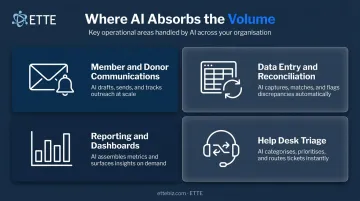
Common areas where AI absorbs volume without adding staff:
- Member and donor communications — automated responses, renewal reminders, and status updates
- Data entry and reconciliation — reducing manual processing in finance and operations
- Reporting and dashboards — surfacing current metrics without analyst intervention
- Help desk triage — routing and resolving routine requests before staff involvement
Faster, Better-Informed Decisions
That capacity advantage only holds if leadership can act on timely information. AI compresses the gap between data collection and insight generation, giving boards, executive directors, and department heads current information when decisions need to be made. For organizations navigating budget cycles, membership trends, or operational disruptions, the difference between last quarter's report and this week's data is the difference between reacting and planning.
Common Challenges in AI Adoption — and How to Address Them
Data Readiness
AI is only as effective as the data it learns from. Gartner reports that 63% of organizations either lacked or were unsure they had the right data management practices for AI, and forecasts that through 2026, 60% of AI projects unsupported by AI-ready data will be abandoned.
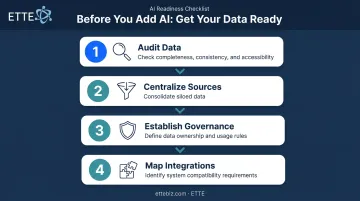
Before investing in any AI tool, organizations should:
- Audit existing data for completeness, consistency, and accessibility
- Centralize siloed data sources where possible
- Establish governance policies that define who owns data and how it can be used
- Identify integration requirements with existing systems
Change Resistance and Staff Concerns
SHRM research found 18% of U.S. workers are very or extremely concerned AI will displace their job within one year, rising to 35% within five years. That concern is real and deserves a direct response.
Successful adoption involves:
- Clear, early communication about what AI will and won't change
- Involving staff in the rollout process, not just notifying them afterward
- Framing AI as a tool that removes tedious work, not people
AI is also generating new roles. The World Economic Forum's Future of Jobs Report identifies AI and machine learning specialists among the fastest-growing categories through 2030, with two-thirds of surveyed employers planning to hire for AI skills.
Lack of In-House Expertise and Governance
Most smaller organizations don't have dedicated data scientists or AI specialists. Without clear policies on data use, privacy, and AI oversight, organizations risk compliance exposure and unpredictable outputs.
The NIST AI Risk Management Framework organizes responsible AI work around four functions: Govern, Map, Measure, and Manage — a practical starting point for organizations building their first governance model. A basic framework should address:
- Who is accountable for AI decisions and outputs
- How data privacy and compliance requirements are met
- How vendor tools are evaluated against actual organizational needs
Vendor selection is critical here. Organizations without internal AI expertise are vulnerable to purchasing decisions driven by vendor pitches rather than genuine fit — making objective evaluation criteria essential before any commitment.
How to Start Adopting AI Solutions in Your Organization
Start With a Specific Problem, Not a Technology
Identify one high-friction process — a bottleneck, a manual task consuming disproportionate staff time, or a recurring decision made on incomplete data. Evaluate whether an AI solution addresses it with measurable ROI. Adopting AI for its own sake produces poor results and staff resistance.
The question to ask: What problem would be meaningfully smaller if this worked well?
Assess Data and Infrastructure Readiness
Before selecting any AI tool:
- Conduct a data audit — identify where data lives, who owns it, and whether it's clean and accessible
- Establish governance policies — define what data is safe for AI use and what should never be exposed
- Map integration requirements — understand how a new tool will interact with existing systems
- Surface shadow AI — identify tools staff are already using without organizational oversight or approval
Work With a Vendor-Neutral Advisor
Organizations without deep internal IT expertise benefit from a partner who evaluates AI tools objectively, designs a governed adoption framework, and builds security and compliance considerations in from day one.
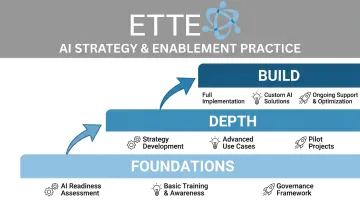
ETTE's AI Strategy & Enablement practice is structured across three tiers: Foundations, Depth, and Build. The Foundations tier covers current use and risk discovery, leadership goal alignment, data boundary setting, and a 90-day pilot design — the right starting point for most organizations. The Build tier (focused on agentic AI and custom workflow development) is intentionally gated until the use case, data, and governance model are confirmed ready.
For organizations wanting to self-assess before engaging, ETTE offers a Readiness Check at ettebiz.com/readiness-assessment.
Pilot, Measure, and Iterate
Start with a clearly scoped pilot project. Define success criteria before launch — hours saved, error rate reduction, response time improvement — and use those results to build organizational confidence before expanding. A narrow, well-measured pilot produces useful data. A broad rollout without measurement produces uncertainty.
Frequently Asked Questions
What are AI business solutions?
AI business solutions are tools and systems that use technologies like machine learning, NLP, and predictive analytics to help organizations automate tasks, analyze data, and make smarter operational decisions. Most don't require deep technical expertise to use — the complexity sits inside the tool, not in the hands of the person using it.
What is the best AI solution for business?
The right choice depends on your specific challenges, existing systems, data quality, and goals. Start by identifying the highest-friction process in your operations and evaluate tools that address it with a clear, measurable outcome — not by chasing the most-discussed platform.
How can small businesses and nonprofits benefit from AI solutions?
AI helps smaller organizations scale capacity without proportional staff growth, automating routine communications, financial processes, and reporting so lean teams can focus on core programs. The efficiency gains matter most where budgets are tight and headcount can't grow with demand.
What are the risks of implementing AI in business?
The most common risks are poor data quality producing unreliable outputs, weak governance creating compliance exposure, and staff resistance undermining adoption. Each is manageable with proper planning, a clear governance model, and advisory support before tools are selected.
How do I know if my organization is ready for AI?
Readiness comes down to having a specific, defined problem AI could realistically solve, reasonably clean and accessible data to support it, and leadership buy-in for a governed, phased rollout. If those aren't in place yet, building them is where to start.