These aren't edge cases — they're the predictable result of managing technology without a structured system.
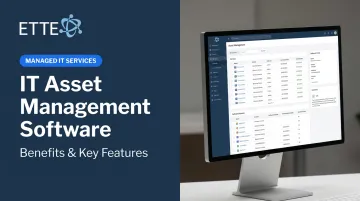
IT asset management (ITAM) software is often treated as an enterprise concern, but its value is just as real for nonprofits, associations, and small businesses managing lean budgets and limited IT capacity. This article explains what ITAM software is, the features that matter most, and the concrete operational advantages it delivers.
Key Takeaways
- ITAM software centralizes tracking of every hardware, software, and cloud asset from purchase through retirement
- Core benefits include measurable cost reduction, stronger security posture, and audit-ready compliance records
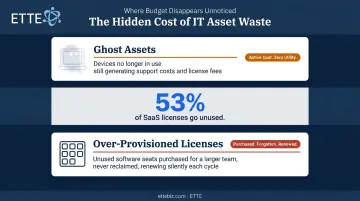
- Productiv's analysis of nearly 100 million SaaS licenses found 53% go unused — a direct cost drain ITAM can prevent
- Without consistent ITAM practices, ghost assets, unpatched devices, and compliance gaps drive up costs and create audit exposure
What Is IT Asset Management Software?
IT asset management software is a system that tracks and manages every technology resource an organization owns — hardware (laptops, servers, network devices), software (licenses, applications), and cloud assets (SaaS subscriptions) — from the moment of purchase through end of life.
IBM defines ITAM as end-to-end tracking that combines financial, contractual, and inventory data to ensure assets are properly used, maintained, upgraded, and disposed of. The ISO/IEC 19770-1 standard — reviewed and confirmed in 2024 — applies this framework to organizations of all sizes, not just large enterprises.
More Than a Record-Keeping Tool
ITAM software exists to support decisions: giving leadership and IT teams accurate answers to questions like:
- What technology do we actually own, and what is it costing us?
- Which assets are creating security or compliance exposure?
- What needs to be replaced, renewed, or retired in the next 12 months?
Without a system to answer those questions reliably, organizations default to guesswork. A 2020 Ivanti survey found that 43% of IT professionals still tracked assets in spreadsheets — a method that creates gaps, not clarity.
ITAM software replaces that reactive approach with a single, accurate source of truth — one that reflects what you actually own, what it costs, and what requires attention next.
Must-Have Features of IT Asset Management Software
Automated Asset Discovery
Effective ITAM software scans networks and cloud environments automatically to detect every connected device and installed application. This eliminates the inevitable gaps in manual tracking.
Two discovery methods matter here:
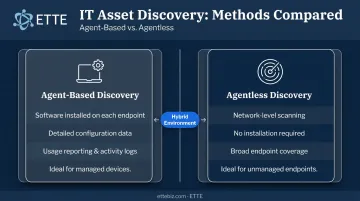
- Agent-based discovery: Software installed on each device reports back detailed configuration and usage data
- Agentless discovery: Network-level scanning identifies devices without requiring installation on each endpoint
Hybrid environments — mixing on-premises hardware, remote devices, and cloud services — require both. Coverage gaps in either direction create blind spots.
Lifecycle Tracking and Financial Visibility
ITAM software should track each asset from procurement through retirement, including:
- Purchase cost and depreciation schedule
- Warranty status and expiration dates
- Contract and renewal dates
- Planned refresh timeline
Intel recommends a 3-to-4-year PC refresh cycle, noting that delayed replacement drives higher support costs, productivity loss, and security exposure. Without lifecycle tracking, organizations miss these windows and end up paying for emergency replacements and extended support contracts instead.
License and Compliance Management
This is where ITAM software has the most direct financial and legal impact. License management monitors software entitlements against actual usage, flagging two distinct problems:
- Over-licensing: Paying for seats nobody uses
- Under-licensing: Running software in excess of purchased entitlements — a compliance violation
Both are common. Zylo's dataset of 30 million licenses found only 49% of provisioned licenses were actively used. The gap between what organizations pay for and what they actually use represents the largest single source of recoverable IT waste — particularly for nonprofits and small businesses managing tight budgets.
Reporting, Dashboards, and Integrations
Asset data only matters when it drives decisions. ITAM software should translate raw data into actionable output:
- Utilization rates by asset category
- Lifecycle and renewal calendars
- Security gap reports (unpatched, end-of-life, unauthorized devices)
- Budget forecasts based on refresh schedules
Integrations with ITSM platforms, service desks, and security tools ensure asset context is available where decisions actually get made. Without those connections, ITAM data stays siloed — useful in theory, ignored in practice.
Key Benefits of IT Asset Management Software
Benefit 1: Cost Control and Elimination of Waste
ITAM software gives organizations an accurate picture of what they own and what they're spending — enabling them to cut redundant tools, reclaim unused licenses, and base purchase decisions on real usage data.
How it works in practice:
Automated discovery surfaces two categories of waste most organizations don't know they have:
- Ghost assets: Devices that appear in purchase records but are no longer in use, still generating support costs or license fees
- Over-provisioned licenses: Software seats that were purchased for a larger team, never reclaimed when headcount changed
Consolidating this into one system replaces the scattered spreadsheets and institutional memory that typically drive IT purchasing.
Why this matters for nonprofits and small businesses:
Budget pressure is constant in mission-driven organizations. Every dollar spent on an unused software seat or a device that was retired two years ago is a dollar not available for programs. ITAM gives finance and leadership teams the data to cut waste confidently — and to forecast future IT spend based on actual lifecycle stages.
KPIs this moves:
- IT spend per employee
- Software license utilization rate
- Number of ghost or untracked assets
- Cost avoidance from reclaimed licenses
When it matters most: Budget reviews, audits, periods of rapid staff turnover, and organizational scaling — any situation where invisible assets become visible costs.
Benefit 2: Stronger Security Posture and Reduced Risk
ITAM software helps organizations identify security vulnerabilities tied directly to their asset inventory — unpatched devices, end-of-life software, unauthorized hardware, and shadow IT that bypasses standard controls.
How it works in practice:
An accurate, continuously updated inventory lets IT teams flag:
- Devices that have missed patches or haven't been scanned recently
- Endpoints running unsupported operating systems
- Hardware connecting to the network that isn't in the asset register
An unregistered device appearing on the network is a meaningful security signal — one that a spreadsheet-based process won't catch in real time.
The 2025 Verizon Data Breach Investigations Report found vulnerability exploitation appeared in 20% of breaches, up 34% year over year. Edge vulnerabilities were fully remediated only 54% of the time, with a median remediation time of 54 days. Assets that aren't in an inventory don't get patched — and unpatched assets are where attackers find their footing.
Why this matters for nonprofits:
A UC Berkeley CLTC study found that 85% of surveyed nonprofits had experienced at least one cyberattack. For organizations handling donor records, member information, or client files, a single incident can be operationally and reputationally devastating. ITAM reduces this exposure by ensuring every device and application is known, documented, and monitored.
KPIs this moves:
- Number of unpatched or end-of-life assets
- Mean time to detect unauthorized devices
- Security incident frequency
- Cyber insurance readiness metrics
When it matters most: Organizations subject to HIPAA, PCI-DSS, NIST, or DFARS requirements, and any organization managing sensitive constituent data.
Benefit 3: Compliance Readiness and Audit Preparedness
ITAM software generates the structured, documented asset history that compliance audits require — software license records, hardware lifecycle data, and a full chain of custody for each asset. Instead of reconstructing records under deadline, organizations can produce audit evidence on demand.
How it works in practice:
License compliance monitoring tracks entitlements against actual installations continuously. When a discrepancy appears, the system alerts the team before it becomes an audit finding. Lifecycle records provide the historical documentation that governance frameworks, grant compliance requirements, and software publisher audits demand.
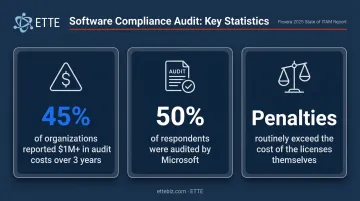
Flexera's 2025 State of ITAM Report found that 45% of organizations reported more than $1 million in audit costs over three years, with Microsoft auditing 50% of respondents. These figures reflect enterprise scale, but software publishers audit organizations of all sizes. The penalties for non-compliance routinely exceed the cost of the licenses themselves.
Why this matters beyond large organizations:
For organizations accountable to boards, donors, and regulators, an auditable asset record demonstrates responsible stewardship of every technology resource the organization relies on. That's a concrete signal to funders and insurers — not just a compliance checkbox.
ETTE incorporates asset and environment documentation as a core component of its managed IT service for nonprofits and small businesses in Washington, DC. Documentation is maintained continuously — not just at onboarding — and feeds directly into the compliance evidence that auditors, funders, and insurers look for.
KPIs this moves:
- Software compliance rate
- Audit preparation time
- Number of compliance exceptions found
- Cost of audit remediation
When it matters most: Software publisher audits, grant reporting periods, board reviews, and during periods of rapid tool adoption.
What Happens When ITAM Is Ignored
Operating without ITAM software doesn't create one large, obvious problem. It creates a slow accumulation of smaller ones that compound over time.
Common patterns in organizations that manage assets informally:
- Ghost assets accumulate: devices lost, retired, or replaced still appear in purchase records, generating ongoing support costs and license fees
- Security gaps grow undetected — unpatched or end-of-life devices stay on the network because no one has a reliable inventory to review; unauthorized devices connect without triggering any alert
- Compliance violations surface at the worst moments, whether during a vendor audit, a renewal negotiation, or a grant reporting period, when there's no time to reconstruct records
- IT planning becomes reactive: without lifecycle data, refresh decisions get made in response to failures rather than in advance of them
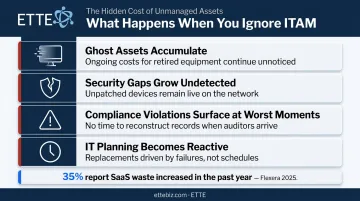
According to Flexera's 2025 State of IT Visibility report, complete technology-stack visibility had declined among IT teams, with 35% reporting that SaaS waste had increased in the preceding year. For smaller organizations without dedicated asset management, these gaps tend to widen quietly — until an audit, a security incident, or a budget conversation forces the issue.
How to Get the Most Value from Your ITAM Software
ITAM software delivers value through consistency, not just implementation. The organizations that see the strongest returns treat asset management as an ongoing operational discipline — not a one-time setup project.
Three practices that separate effective ITAM from shelf-ware:
- Run discovery continuously. Assets change: devices are added, removed, and reassigned. Stale inventory is nearly as dangerous as no inventory at all.
- Review lifecycle data on a regular cadence — quarterly reviews that connect asset status to upcoming budget and procurement decisions are where ITAM data earns its value.
- Act on the data. The most common failure mode is completing an initial inventory and letting that data go stale as the environment evolves. Build a repeatable process, not just a platform.
For organizations without a dedicated internal IT team, maintaining ITAM accuracy is often best handled by a managed IT partner who documents the environment from day one and weaves asset visibility into regular service reviews.
ETTE builds and maintains documented asset environments for nonprofits and small businesses in Washington, DC. That means documenting systems, accounts, and configurations before making any changes — then incorporating technology lifecycle tracking into quarterly service reviews so leadership always has a current, actionable view of their environment.
Conclusion
IT asset management software's value is straightforward: it replaces assumption with evidence. Organizations that know what technology they own, what it's costing them, and where it creates risk can make better decisions — and avoid the reactive, expensive problems that arise when technology outgrows the ability to track it.
The advantages compound over time. Renewals caught before they lapse, ghost assets removed from the books, vulnerabilities identified before they become breaches — these gains accumulate in ways that spreadsheets and manual processes cannot reliably sustain.
ITAM works best as an ongoing discipline, not a one-time cleanup. Organizations that maintain it consistently gain a durable advantage: they already know the state of their environment when decisions need to be made — rather than scrambling to find out.
Frequently Asked Questions
What is an IT asset management system?
An IT asset management system is a platform that centralizes tracking, lifecycle management, and compliance monitoring of all technology assets an organization owns (hardware, software, and cloud subscriptions) from procurement through retirement. It replaces spreadsheets and manual processes with automated discovery, structured records, and actionable reporting.
What software is used for asset management?
Common ITAM tools include ManageEngine AssetExplorer, Lansweeper, ServiceNow IT Asset Management, Freshservice, and InvGate Assets — each sized differently, with Lansweeper fitting smaller organizations and ServiceNow built for enterprise. The right choice depends on your discovery requirements, existing tools, and how the data will be used operationally.
What is the best IT asset management software?
The right software depends on your organization's size, asset complexity, budget, and priorities — hardware tracking, license management, cloud visibility, or service desk integration. Evaluate tools against your specific use cases and run a trial period before committing.
What are the key features of IT asset management software?
Core capabilities to prioritize: automated discovery (agent-based and agentless), centralized asset inventory, lifecycle and financial tracking, software license compliance monitoring, and dashboards that connect asset data to business decisions. Integration with ITSM and security platforms ensures that data is usable where decisions actually happen.
What happens if you don't have IT asset management software?
Without ITAM, organizations typically accumulate ghost assets — paying for devices or licenses that are no longer in use. Untracked equipment creates security gaps, and incomplete records expose organizations to compliance risk during audits. Every problem compounds as the environment grows and records drift further from reality.
How does IT asset management software help with compliance?
ITAM software tracks software licenses against actual usage, maintains a documented history of each asset including purchase records and audit trails, and flags license gaps or end-of-life assets before they become violations. When an audit arrives, organizations produce evidence on demand rather than reconstructing records under deadline pressure.