Introduction
Picture this: a Washington, DC nonprofit discovers that donor records and financial data were exposed — not because of a dramatic system failure, but because an attacker quietly moved through their network for months before anyone noticed. No alarms went off. No one was watching. The breach only surfaced during an unrelated audit.
This scenario plays out constantly. Verizon's 2024 Data Breach Investigations Report found that small organizations face a disproportionate share of confirmed breaches — targeted precisely because attackers assume their defenses are weaker. Limited IT staff and lean security budgets make smaller organizations easier to compromise and harder to detect in.
Managed Detection and Response (MDR) exists to close that gap. It gives resource-constrained organizations the expert monitoring, threat hunting, and active response that no small IT team can realistically deliver alone.
If your organization is trying to understand whether MDR belongs in your security stack — and what it actually does — this guide breaks it down clearly.
Key Takeaways
- MDR combines continuous monitoring, human expertise, and active response — not just alerting
- Small organizations are frequent breach targets, regardless of size or mission
- MDR delivers SOC-level security without the cost of building one in-house
- ETTE's GuardRail reporting turns security posture data into plain-language summaries boards can actually use
- Choosing the right MDR provider means confirming true 24/7 coverage and defined response authority
What Is Managed Detection and Response (MDR)?
MDR is a cybersecurity service that pairs advanced technology with a dedicated team of human analysts to continuously monitor your systems, detect threats in real time, and actively respond — containing and eliminating threats rather than just sending alerts for someone else to handle.
Beyond Software: What Makes MDR Different
Traditional security tools — antivirus, basic firewalls, even endpoint detection software — generate alerts. What they don't do is investigate those alerts, determine which ones are real, and take action. That's left to whoever is managing the tools internally.
For a nonprofit with two IT staff handling everything from printer issues to staff onboarding, that's not a realistic expectation.
MDR changes the equation by making the provider responsible for the full cycle:
- Continuous monitoring — 24/7 visibility across endpoints, networks, cloud environments, and identity systems
- Proactive threat hunting — human analysts actively searching for threats that automated tools miss
- Managed investigation and response — when a threat is confirmed, the provider contains it, not just documents it
- Security posture optimization — ongoing improvements based on what incidents reveal about gaps
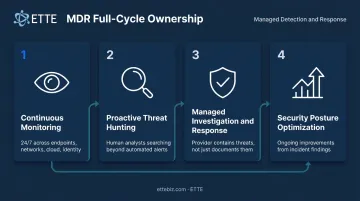
That full-cycle ownership is reflected in how the industry defines the service. Gartner defines MDR as "remotely delivered, human-led, turnkey, modern SOC functions" delivering cyberattack disruption and containment. The emphasis on human-led and containment is what separates MDR from tools that simply monitor and notify.
Who MDR Is Built For
MDR is especially valuable for organizations that don't have a dedicated internal security team or Security Operations Center (SOC). A single information security analyst costs a median of $124,910 per year according to the Bureau of Labor Statistics — and a properly staffed SOC typically requires two to ten people. That's before tools, infrastructure, or after-hours coverage.
For organizations with 10–150 staff, MDR delivers equivalent capability at a fraction of that cost. ETTE builds MDR into its security baseline as a foundational control, not an optional add-on. It's been a core part of how ETTE has protected Washington, DC nonprofits, associations, and small businesses since 2002.
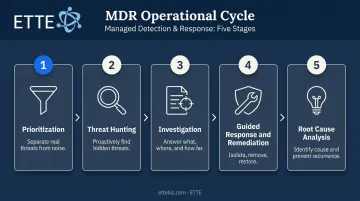
How MDR Works: The Five Core Steps
MDR operates as a continuous cycle, not a one-time event. Here's how a mature MDR operation handles threats from first signal to final lesson.
Step 1: Prioritization
Modern security environments generate an enormous volume of alerts daily. MDR teams combine automation with human review to separate real threats from false positives, ensuring the most critical issues get immediate attention. This prevents alert fatigue — the paralysis that sets in when small IT teams are buried in noise and can't distinguish what actually needs action. For nonprofits and small organizations with lean IT staff, this triage function alone justifies the service.
Step 2: Threat Hunting
Not every threat announces itself. Human analysts proactively search for hidden or advanced threats by studying behavioral patterns, attacker tactics, and threat intelligence signals. This happens before a breach is confirmed — the goal is to find what automated systems miss before damage occurs.
Step 3: Investigation
Once analysts flag a potential threat, they dig in. The investigation answers four key questions:
- What happened and when did it start?
- Which systems were affected or exposed?
- How far did the attacker move laterally?
- What needs to happen to contain and recover?
The result is a scoped picture of the incident, not a raw alert dump.
Step 4: Guided Response and Remediation
MDR goes beyond detection. The provider takes direct action: isolating affected systems, removing malware, cleaning compromised configurations, and restoring endpoints to a known good state. Clients are guided through the process, or certain pre-approved actions are taken immediately without waiting for approval, depending on the service agreement.
Step 5: Root Cause Analysis
After the threat is neutralized, the MDR provider identifies how the attack happened and what changes would prevent recurrence. Every incident closes with specific recommendations — patching a misconfiguration, tightening access controls, updating detection rules — so the next attacker finds a harder target.
Key Benefits of MDR for Nonprofits and Small Organizations
24/7 Coverage Without Added Headcount
Threats don't respect business hours. A ransomware deployment or credential-stuffing attack at 2 AM on a Sunday will sit undetected until someone arrives Monday morning. No one is watching overnight — unless you have MDR.
MDR provides around-the-clock monitoring and expert response without requiring organizations to hire additional staff or build shift coverage. For nonprofits and small businesses that can't realistically staff a security operation overnight or on holidays, this is the clearest practical benefit.
Faster Detection and Response
IBM's 2025 Cost of a Data Breach Report found that the global mean breach lifecycle — from identification through containment and service restoration — is 241 days. Every day a threat goes undetected, the potential damage and recovery cost grows.
MDR compresses that window. While provider-reported figures vary, leading MDR services document mean response times measured in minutes for high-priority incidents, not months.
Reduced Compliance and Reputational Risk
For nonprofits handling donor data, associations managing member records, or small businesses processing client information, a breach doesn't just cause technical damage. It destroys trust.
DC organizations also face specific legal obligations. Under the District's data breach notification law, any organization maintaining DC residents' personal information must notify affected individuals and the DC Attorney General without unreasonable delay for breaches affecting 50 or more residents.
MDR supports compliance by providing:
- Security controls that meet notification and data protection requirements
- Audit-ready documentation for boards, funders, and regulators
- Incident records that demonstrate due diligence if a breach occurs
Cost-Effective Access to Expert Security
Building an in-house SOC with skilled analysts, threat hunters, and incident responders is simply out of reach for most organizations with 10–150 staff. MDR delivers equivalent capability at a predictable monthly cost: no recruiting costs, no benefits overhead, no overnight staffing gaps.
This aligns directly with how ETTE structures its managed security services: specialized cybersecurity talent spread across clients, giving each organization access to expertise they couldn't justify hiring individually.
Board-Ready Reporting and Security Visibility
Leadership needs to understand security status without wading through technical reports. MDR generates plain-language incident summaries, posture trends, and actionable recommendations that boards and executive directors can actually use.
ETTE's GuardRail security posture scoring is built specifically for this. It tracks five core areas and delivers quarterly reports formatted for board packs, funder questionnaires, and due-diligence requests:
- Overall posture score
- Identity and access controls
- Configuration and controls
- Security-awareness readiness
- Remediation roadmap with named owners
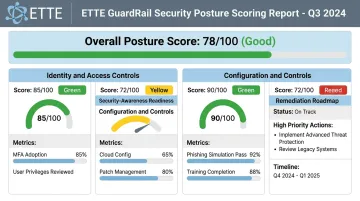
No technical background required to read it.
MDR vs. MSSP vs. EDR: What's the Difference?
MDR, MSSP, and EDR each solve a different problem — and confusing them leads to gaps in coverage.
| MDR | MSSP | EDR | |
|---|---|---|---|
| Type | Managed service | Managed service | Software tool |
| Primary function | Detect, investigate, respond | Monitor and alert | Endpoint monitoring |
| Human-led response? | Yes | Typically no | No |
| Takes action on your behalf? | Yes | Rarely | No |
| Best for | Organizations without internal security team | Organizations needing monitoring at scale | Teams that can act on alerts themselves |
The table captures the key distinctions, but the practical differences matter more than the labels.
MDR vs. MSSP
Managed Security Service Providers traditionally manage security infrastructure and forward alerts — they flag potential threats but leave investigation and response to the customer. MDR providers actively investigate and remediate, making them the right fit for organizations without in-house investigation capacity.
MDR vs. EDR
Endpoint Detection and Response (EDR) is software, not a service. It monitors individual devices and surfaces alerts — but those alerts still need someone qualified to interpret and act on them. Many organizations have EDR deployed and still experience breaches — not because the tool failed, but because no one with the right expertise was available to act on what it found. MDR uses EDR as one layer in a broader service, with analysts who investigate and respond so the alerts don't go unaddressed.
When to Choose What
- EDR only — organizations with a mature internal security team capable of acting on alerts
- MSSP — organizations needing monitoring and alerting at scale with some internal response capacity
- MDR — organizations that want proactive detection, human-led investigation, and managed remediation without building those capabilities in-house
For nonprofits, associations, and small businesses in particular, MDR closes the gap that EDR tools and alert-only monitoring leave open.
What to Look for When Choosing an MDR Provider
Expertise, Transparency, and Communication Style
Ask providers how they communicate with your leadership team when an incident occurs. Can they explain findings in plain language without jargon? Do they provide regular security health reviews, or only reach out when something goes wrong? The strongest MDR providers act as an extension of your team — keeping leadership informed without requiring a security degree to follow along.
True 24/7 Coverage and Defined Response Authority
"24/7 monitoring" means different things to different providers. Confirm:
- Is human analysis available around the clock, or just automated alerting?
- What containment actions can the provider take immediately without waiting for your approval?
- What requires your sign-off before action is taken?
A provider that can only alert — not act — during off-hours leaves a critical gap open exactly when attackers prefer to move.
Fit for Your Organization's Size and Sector
An MDR provider built for enterprise environments will bring enterprise assumptions — pricing, complexity, and communication styles that don't translate to a 30-person nonprofit. Look for a provider with documented experience in organizations similar to yours in size, data sensitivity, and operational constraints.
Good fit indicators include:
- Experience with organizations in your staff size range (not just large enterprise deployments)
- Familiarity with your sector's data sensitivity and compliance requirements
- Pricing structures designed for lean budgets, not Fortune 500 IT departments
ETTE has worked with Washington, DC nonprofits, associations, and small businesses since 2002. That history shapes how security strategies get scoped here — around lean teams, grant-funded budgets, and board oversight requirements rather than assumptions built for much larger organizations.
Frequently Asked Questions
What is a managed threat detection service?
A managed threat detection service is a cybersecurity offering where a third-party team monitors your systems around the clock, identifies potential threats using advanced tools and human expertise, and either alerts you or takes action directly. It's particularly valuable for organizations without in-house security analysts.
Is a managed threat detection service worth the cost?
For most small organizations, yes. MDR typically costs far less than a data breach, regulatory penalties, or hiring equivalent security staff — and a predictable monthly fee makes budgeting straightforward.
What is the difference between MDR and MSSP?
MSSPs primarily monitor and alert, leaving investigation and response to your team. MDR providers actively investigate confirmed threats and take remediation steps on your behalf — making MDR a more hands-on, direct service for organizations without internal security capacity.
Do small organizations and nonprofits need MDR services?
Small organizations are frequently targeted precisely because attackers assume their defenses are weaker. MDR fits organizations of any size, particularly those without a dedicated security team or the resources to staff 24/7 coverage on their own.
What types of threats can MDR detect?
MDR services are built to catch threats that automated tools alone often miss. Coverage typically includes ransomware, phishing, malware, insider threats, unauthorized access, lateral movement, advanced persistent threats, and zero-day exploits.