
Introduction
Most organizations hear about AI constantly: from board members, funders, peer organizations, and the news. What they rarely hear is where to start. Without a clear starting point, AI adoption follows one of two paths — reactive tool purchases that go unused, or complete paralysis from not knowing what's safe.
Gartner reports that only 1 in 5 AI initiatives achieves ROI, and at least 50% of generative AI projects were abandoned after proof of concept by the end of 2025. The pattern behind these failures is consistent: poor use-case selection, unclear business value, and no governance framework in place before tools were adopted.
An AI roadmap changes that equation. It gives organizations a structured, sequenced plan that connects AI decisions to real goals — before any tools are purchased. This guide walks through how to build one, specifically for nonprofits, associations, and small businesses with 10 to 150 staff.
Key Takeaways
- An AI roadmap defines which AI initiatives to pursue, in what order, and with what governance to keep them aligned to organizational goals.
- Most AI efforts fail because of poor use-case selection and missing governance, not lack of technology.
- Readiness assessment must come before tool selection, every time.
- For small organizations, the highest-value AI use cases are operational, not transformational.
- Shadow AI is already present in most organizations; a roadmap brings it under governance.
What Is an AI Roadmap?
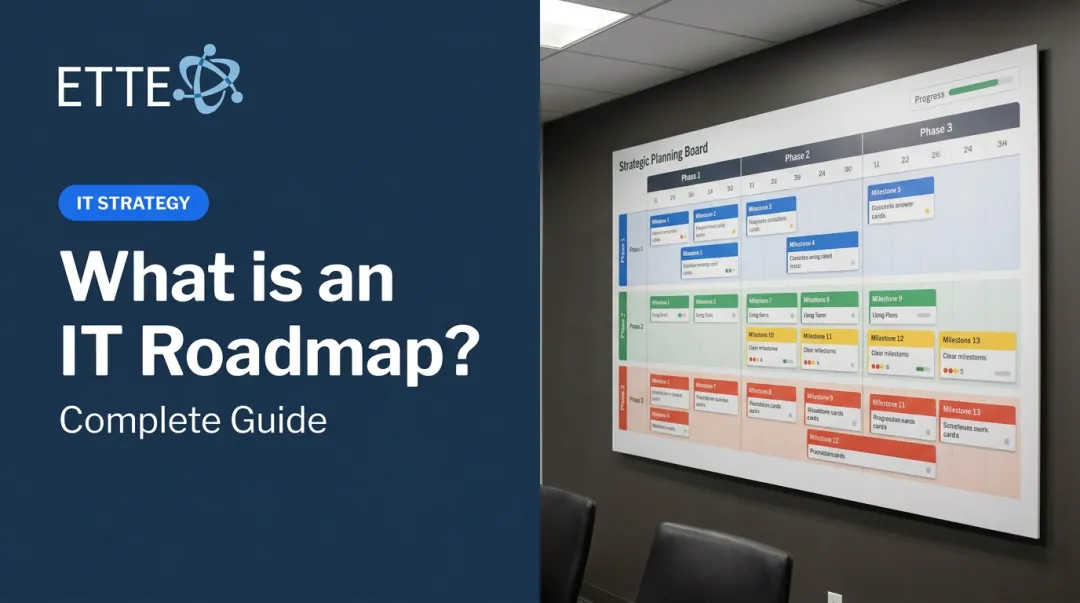
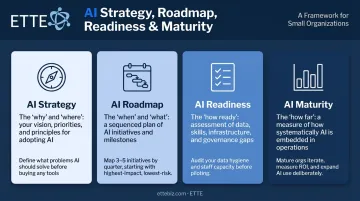
An AI roadmap is a living document that outlines which AI initiatives an organization will pursue, in what order, and with what resources. It connects technology decisions to mission and business goals — and it changes as conditions change.
Two terms that often get conflated:
| Concept | Definition | Small-Org Application |
|---|---|---|
| AI strategy | Direction: desired outcomes, principles, and what's out of scope | States why AI matters and what won't be touched |
| AI roadmap | Sequenced implementation plan with owners, dependencies, and measures | Maintains a short, revisable portfolio — not a transformation program |
| AI readiness | Current ability to begin safely across data, people, tech, and governance | Identifies prerequisites before any tool selection |
| AI maturity | Developed, repeatable AI capability demonstrated over time | Measured after implementation begins, not before |
A good AI roadmap has four characteristics:
- Grounded in where the organization actually stands today — not where it hopes to be
- Ranks use cases by demonstrable value and feasibility, not excitement or vendor hype
- Addresses risk, data privacy, and vendor accountability from the start — not as an afterthought
- Treated as a working document that gets updated as conditions, tools, and priorities shift
These characteristics also define what a roadmap is not: an IT infrastructure plan, a software procurement list, or a promise of rapid transformation.
How to Build an AI Roadmap: A Step-by-Step Framework
There is no universal AI roadmap template. The right sequence depends on your organization's AI maturity, data quality, staff capacity, and strategic priorities. The framework below is designed for lean organizations that need practical progress — not a multi-year enterprise overhaul.
Step 1: Assess Your AI Readiness
Before anything else, conduct an honest audit across five dimensions:
- Data quality and availability — Is your data consistent, accessible, and documented?
- Technology infrastructure — Do your current systems support integration with new tools?
- Staff AI literacy — Can your team evaluate, adopt, and oversee AI tools without dedicated technical staff?
- Budget constraints — What can you realistically spend on tools, training, and ongoing oversight?
- Workflow suitability — Which current processes could genuinely benefit from automation or AI assistance?
Microsoft's AI readiness framework assesses strategy, technology and data, experience, culture, and governance. A 2025 SME research model adds organizational, environmental, and human factors to that mix. Neither reduces readiness to a single score — and neither should you.
This audit determines where your roadmap starts. Without it, you're scoping pilots around tools you've heard of rather than gaps you've actually mapped.
Step 2: Identify and Prioritize Use Cases
Gartner's recommended approach evaluates AI use cases across two dimensions: business value (time saved, cost reduced, mission impact) and feasibility (data availability, implementation complexity, staff adoption likelihood).
For small organizations, that feasibility dimension should also include:
- Data sensitivity and privacy obligations
- Workflow fit with existing processes
- Vendor terms and data handling practices
- Staff capacity for adoption and oversight
Start with one or two high-value, low-complexity use cases — not broad transformation. For nonprofits and small businesses, practical starting points often include:
- Document summarization and internal knowledge drafting
- Donor or member communication drafts for staff review
- FAQ handling for routine inquiries
- Scheduling and intake workflow automation
Custom model development is not on this list. For most organizations at this stage, it introduces cost and complexity that outpaces the available benefit.
Step 3: Build a Governance and Risk Framework
Governance answers four questions most organizations skip:
- Who approves which AI tools for organizational use?
- How is data privacy maintained when staff use these tools?
- What happens when an AI output is wrong or harmful?
- How are vendors evaluated before adoption?
NIST's AI Risk Management Framework structures this through four functions: Govern, Map, Measure, and Manage. Its GenAI Profile adds specific actions for purchased tools — inventorying third parties with data access, documenting incidents, and clarifying contractual responsibilities.
In practice, most organizations skip this step and pay for it later. ETTE's vendor-neutral AI advisory work helps small organizations establish these guardrails before deployment — giving boards and leadership teams what they need to actually endorse AI use rather than quietly tolerate it.
One pattern ETTE consistently encounters with DC-area nonprofits: most teams already have shadow AI and no governance model. Staff are using unvetted tools, but no one owns the risk. The governance framework is what converts that invisible exposure into a managed, defensible practice.
Step 4: Plan Implementation and Measure Progress
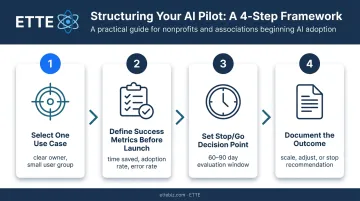
Structure your first implementation as a defined pilot — not an open experiment:
- Select one use case with a clear owner and a small, defined user group
- Define success metrics before launch — time saved, adoption rate, error rate, output quality
- Set a stop/go decision point — typically a 60–90 day evaluation window
- Document the outcome — a written recommendation to scale, adjust, or stop
ETTE's AI Foundations engagement formalizes this structure: a fixed-scope first engagement covering governance basics, pilot design, and a defined 90-day review. The pilot phase includes pre-launch criteria — a clear owner, allowed and appropriate data, defined success measures — so that evaluation is evidence-based rather than impressionistic.
Without pre-defined metrics, a pilot has no clear endpoint — and organizations tend to keep running tools indefinitely rather than deciding whether they're actually working.
Key Factors That Shape AI Implementation for Small Organizations
Data Readiness Is Usually the Hidden Bottleneck
Gartner forecasts that through 2026, 60% of AI projects unsupported by AI-ready data will be abandoned. AI tools perform only as well as the data they access — and many small organizations have inconsistent, siloed, or undocumented data that must be addressed first.
A Salesforce study found that 66% of growing SMBs reported an integrated technology stack, compared to only 32% of declining ones. Data readiness isn't just an AI prerequisite; it correlates with organizational performance broadly.
Staff Capacity and Change Readiness Matter as Much as Technology
Microsoft and LinkedIn's 2024 Work Trend Index found that only 39% of AI users had received company training — while 80% of AI users at small and medium-sized businesses had brought their own AI tools to work without organizational approval.
That gap between tool use and formal training is where AI adoption breaks down. Small teams have limited tolerance for disruption. Deploying a tool without training, clear use case explanation, or workflow integration doesn't just slow adoption — it creates resistance that's hard to reverse.
Budget and Vendor Dependency Risk
Those adoption challenges make tool selection even more consequential. Free or low-cost AI tools often come with tradeoffs: data privacy ambiguities in terms of service, vendor lock-in, or limited support when problems arise.
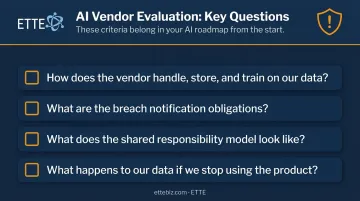
Build vendor evaluation criteria into your roadmap from the start. Key questions before adopting any AI tool:
- How does this vendor handle, store, and potentially train on our data?
- What are the breach notification obligations?
- What does the shared responsibility model look like?
- What happens to our data if we stop using the product?
The FTC has warned that quietly weakening terms of service or repurposing customer data for AI training may constitute unfair or deceptive practices. That risk applies to your vendors, not just your own organization.
Security and Compliance Requirements Must Be Mapped Early
Organizations handling donor data, member records, or grant-funded information face obligations that constrain which AI tools are permissible. These vary by data type and jurisdiction:
- HIPAA applies when you're a covered entity or business associate
- State privacy laws vary by jurisdiction and data type
- Grant funder contracts may add further restrictions beyond baseline legal requirements
ETTE addresses this by establishing documented environments and layered data protection before any new platform touches sensitive data — vetting vendors, enforcing MFA, and maintaining audit logs as baseline practice. That IT security foundation is what makes responsible AI adoption possible for nonprofits and associations operating under these constraints.
Common Misconceptions About AI Roadmaps
"We need a data science team to do this."
Most practical AI tools available to small organizations today are SaaS-based. They require operational judgment and governance, not engineering. The roadmap is about process and decision-making — not custom model development.
"The first step is picking a tool."
This is the most common and most costly mistake. Organizations frequently evaluate and purchase AI software before assessing whether their workflows, data, or team are prepared. Unused licenses and failed rollouts follow. The roadmap determines which tool — if any — is appropriate. Tool selection comes near the end of that process, not the beginning.
"AI readiness means we're not ready yet."
Readiness asks whether the prerequisites exist now. Maturity is what develops over time through repeated, scaled practice. An organization can be ready to benefit from one well-scoped AI use case with modest infrastructure.
That's not the same as needing enterprise-level AI maturity before starting. A well-structured roadmap sets realistic expectations at each stage — it doesn't treat readiness as a binary pass/fail gate.
When an AI Roadmap May Not Be the Right First Step
A roadmap assumes some foundational stability. If the following conditions are present, the roadmap itself is premature:
- Basic IT infrastructure is undocumented or unreliable
- Data is severely fragmented across disconnected systems with no integration path
- Leadership hasn't aligned on a basic digital strategy
- No one currently owns IT compliance or vendor management decisions
AI sits on top of these fundamentals. It doesn't substitute for them.
Infrastructure gaps aren't the only reason a roadmap stalls. Pressure from boards, funders, or peer organizations often pushes tool adoption before anyone has defined a clear use case or success metric. ETTE sees this as a recurring trigger — the board asks what the AI plan is, and leadership needs a real answer.
Organizations in that situation benefit more from an AI readiness assessment than a full roadmap. The assessment determines whether a roadmap is even the right next action, and what foundational conditions would need to be in place before it is.
Frequently Asked Questions
What is an AI roadmap for a small organization?
An AI roadmap for a small organization is a prioritized, practical plan that identifies which AI tools or processes to adopt, in what order, and how to govern them. It focuses on operational value — freeing up staff time, improving accuracy, reducing manual effort — rather than enterprise-scale transformation.
What is the difference between an AI strategy and an AI roadmap?
An AI strategy defines what an organization hopes AI will accomplish and why — the direction and principles. A roadmap translates that intent into sequenced, actionable steps with owners, timelines, and success metrics. Strategy answers "what and why"; the roadmap answers "how and when."
How long does it take to build and implement an AI roadmap?
For a small organization, building the roadmap typically takes four to eight weeks; implementing and evaluating a first use case adds another 60 to 90 days. Data sensitivity, vendor procurement, and leadership review cycles can extend either phase.
How do nonprofits start with AI without a dedicated IT team?
Start with a readiness assessment and one clearly scoped use case, using SaaS tools that require no custom development. An IT advisory partner can handle governance guidance, vendor vetting, and implementation structure without requiring in-house technical staff — ETTE's AI Foundations engagement is built for exactly this with nonprofits in the DC area.
What are the biggest risks of AI adoption for small organizations?
The most common risks are:
- Data privacy exposure from vendors whose terms permit broader data use than assumed
- Staff resistance from tools deployed without training or workflow integration
- Wasted spend from tool adoption without a defined use case or success measure
All three are preventable with a structured roadmap and governance framework in place before deployment.