The stakes are real. According to the 2024 Verizon Data Breach Investigations Report, organizations with 1–1,000 employees experienced 8,302 incidents and 2,031 confirmed breaches in a single year, with System Intrusion, Social Engineering, and Basic Web Application Attacks accounting for 77% of those breaches. Ransomware or extortion appeared in 32% of cases.
Choosing the wrong network security solution — or skipping one entirely — doesn't just create IT problems. It puts donor trust, regulatory standing, and operational continuity at risk. This guide walks through what network security solutions actually are, which types matter most, and how to make a sound decision without overbuilding or underprotecting.
Key Takeaways
- Network security requires layered protection — no single tool covers every threat vector
- Match your solution to your actual risk profile, not the most popular product on the market
- Ransomware and social engineering account for most small-organization breaches
- Compliance (HIPAA, PCI DSS, state privacy laws) shapes which controls you need first
- Managed security services give small organizations enterprise-grade coverage — no full-time security hire needed
What Is a Network Security Solution?
A network security solution is a combination of software, hardware, and policies designed to protect your organization's network, devices, and data from unauthorized access, theft, or disruption. Modern networks extend well beyond a single office. Cloud applications, remote workers, mobile devices, and third-party integrations all create exposure points that need to be actively managed.
Effective network security works through three core functions:
- Protection — Preventing unauthorized access before it occurs through firewalls, access controls, and identity verification
- Detection — Identifying suspicious activity in real time through monitoring, alerts, and behavioral analysis
- Response — Containing and remediating threats quickly to limit damage
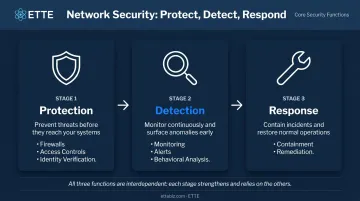
All three functions depend on each other. Without response capabilities, detection only tells you that something went wrong. Without detection, even a strong protection layer won't catch what manages to get through.
Why This Matters for Nonprofits and Small Businesses
Nonprofits and small businesses are frequent targets precisely because attackers assume their defenses are weaker. That assumption is often correct — and the risk is real, because these organizations hold donor records, financial data, HR files, and sometimes regulated health or payment information.
The exposure is higher than most leaders realize.
The practical benefits of getting this right include:
- Protecting donor and member data from unauthorized access or exfiltration
- Meeting compliance requirements such as HIPAA, PCI DSS, and state data privacy laws
- Reducing the financial and reputational cost of a breach
- Maintaining stakeholder and funder trust
- Ensuring operations continue even when an incident occurs
Core Types of Network Security Solutions
Organizations rarely need every security tool available. Understanding the main categories helps you make informed choices about which combination fits your environment.
Next-Generation Firewalls (NGFW)
NGFWs are the first line of defense. They inspect all incoming and outgoing traffic, apply security rules, and block unauthorized or malicious connections. Unlike traditional firewalls, NGFWs perform deep packet inspection, identify application-layer threats, and integrate with live threat intelligence feeds.
For a small organization, an NGFW reduces external exposure without requiring constant manual intervention. It can be configured to match specific risk tolerance and acceptable use policies. Once configured properly, it runs continuously in the background.
Intrusion Prevention Systems (IPS)
IPS tools monitor network traffic in real time for known attack signatures and behavioral anomalies, then actively block threats rather than just alerting on them. They defend against brute force attacks, exploit attempts, and denial-of-service attacks.
IPS is especially valuable during the window between when a vulnerability is discovered and when a patch is applied. Verizon's 2024 DBIR found a median 5 days to mass exploitation after a vulnerability entered CISA's Known Exploited Vulnerabilities catalog, versus a median 55 days for organizations to remediate. That gap is exactly where IPS earns its place.
Zero Trust Network Access (ZTNA)
Zero Trust operates on a simple principle: never trust, always verify. No user or device is trusted by default, even those already on the network. ZTNA enforces strict identity verification and limits access to only the specific resources each user is authorized to reach.
When something goes wrong, the damage stays contained rather than cascading across your entire environment.
VPN and Emerging SASE Frameworks
Remote Access VPN creates encrypted tunnels for remote connectivity, but grants broad access once connected. As distributed work has become the norm, that broad-access model is a meaningful limitation.
SASE (Secure Access Service Edge) addresses this by bundling multiple capabilities into a single cloud-delivered framework:
- ZTNA for identity-based access control
- Firewall-as-a-service for traffic inspection without on-premises hardware
- Secure web gateway for filtering internet-bound traffic
It's increasingly adopted by mid-sized organizations looking to consolidate security tools without adding management complexity.
Key Factors When Choosing the Right Solution
Selecting network security tools isn't a one-size-fits-all decision. Match technical capabilities to your specific operational outcomes, not to brand recognition or what a peer organization chose last year.
Organization Size and IT Complexity
The number of users, devices, locations, cloud applications, and remote workers directly determines how sophisticated a solution needs to be. A 15-person nonprofit with a single office has different requirements than a 120-person association with remote staff and multiple cloud platforms.
Organizations without dedicated IT staff should prioritize solutions that are operationally simple, have strong vendor or managed service provider (MSP) support, and generate clear alerts rather than raw technical data that requires interpretation.
Budget and Total Cost of Ownership
Budget is often the primary constraint, but cost evaluation should extend beyond the purchase price. Total cost of ownership includes:
- Licensing or subscription fees
- Ongoing maintenance and updates
- Staff time to configure, monitor, and manage the solution
- Vendor support or managed service costs
Subscription-based and managed security models often make more sense for smaller organizations than large upfront capital investments. Predictable monthly costs are easier to budget for and easier to justify to a board.
For context: the US median annual wage for an information-security analyst was $124,910 in May 2024, according to the Bureau of Labor Statistics. That's before benefits, tooling, and overhead. Managed security services frequently deliver comparable or broader coverage at a fraction of that cost.
Threat Landscape and Compliance Requirements
The right solution must match your actual threat exposure. Nonprofits handling health data face different risks than advocacy organizations or professional associations. Before evaluating tools, identify your most sensitive data assets and most likely attack vectors — phishing, ransomware, and credential theft are the top three for most small organizations.
Compliance obligations often shape which controls to implement first:
| Framework | Who It Applies To | Key Network Security Requirements |
|---|---|---|
| HIPAA Security Rule | Covered entities and business associates handling electronic health data | Risk analysis, access controls, audit controls, transmission security |
| PCI DSS v4.0.1 | Organizations that store, process, or transmit cardholder data | Network security controls (Requirement 1), segmentation, logging, vulnerability management |
| DC Breach Notification Law | Entities handling DC residents' personal information | Reasonable safeguards; notice within 30 days for breaches affecting 50+ residents |
| Maryland PIPA | Businesses holding Maryland residents' personal information | Reasonable security procedures; Attorney General notification within 45 days |
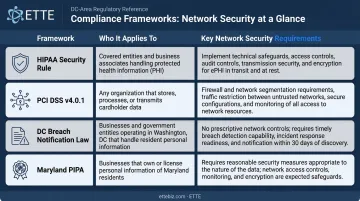
Compliance isn't the same as security. That said, meeting compliance requirements provides a useful baseline for deciding which controls to tackle first.
Scalability and Manageability
The solution must grow with your organization — new staff, additional cloud services, new locations — without requiring a complete rebuild each time the environment changes.
Manageability matters as much as raw capability. A sophisticated tool that requires specialized expertise to operate becomes a liability when your IT function is a small team or an external partner. Look for:
- Centralized management consoles
- Plain-language dashboards and reporting
- Clear, actionable alerts (not raw log data)
- Strong vendor or MSP support included
How ETTE Can Help Secure Your Network
ETTE is a Washington, DC-based managed IT and security partner that has served nonprofits, associations, and small businesses since 2002. Every engagement is built around maintaining a security posture that fits the organization's mission, size, and risk environment — not just deploying tools and moving on.
A Layered Security Stack Without the Overhead
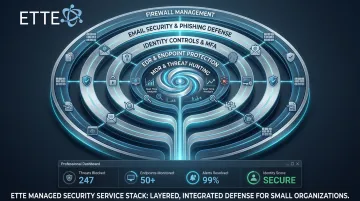
ETTE's managed security offering covers the full range of controls organizations in the 10–150 staff range actually need:
- Managed firewalls — configured and maintained across platforms including Checkpoint, Fortinet, Palo Alto, Juniper, and Cisco
- Managed Detection and Response (MDR) — continuous threat monitoring with active containment, not just alerting
- Endpoint Detection and Response (EDR) — device-level protection across every laptop and desktop
- Email security — phishing, impersonation, and business email compromise protection built into the baseline
- Identity and access controls — MFA enforcement and role-based access across systems
- IDS/IPS — active threat detection and prevention layered alongside the firewall
- Network segmentation — isolating critical systems to limit lateral movement
- SIEM — centralized visibility and correlation across the full environment
- Security awareness training — regular simulations and exercises to reduce human-factor risk
ETTE GuardRail: Security Reporting Leadership Can Actually Use
One of ETTE's key differentiators is GuardRail, a proprietary security posture scoring tool that translates the organization's security status into board-ready reporting. No technical background required.
A typical GuardRail report includes:
- A single posture score with trend tracking over time
- Identity and access status (MFA coverage, conditional access, privileged accounts)
- Configuration review across email, endpoint, web filtering, cloud, and backup systems
- Security awareness readiness and phishing simulation results
- A prioritized remediation roadmap with named owners and target dates
GuardRail reports plug directly into board packs, respond to funder due-diligence requests, and support cyber insurance applications — giving leadership a consistent, documented view of security posture across every reporting cycle.
Built for Organizations Without In-House Security Teams
That same clarity extends to how ETTE structures its service model. It's designed for organizations that need enterprise-grade protection without enterprise-sized budgets or internal security staff. Services are delivered on a predictable monthly basis, with quarterly service reviews and documented environments from day one. Tool selection is vendor-neutral — driven by fit, not vendor relationships.
For organizations that need explicit security governance — such as those facing audits or insurer questionnaires — ETTE's Virtual CISO service adds risk register ownership, policy development, and stakeholder reporting on top of the managed security foundation.
Conclusion
Choosing the right network security solution comes down to matching protection to your actual risk, resources, and operational needs. The most advanced tool on the market isn't automatically the right fit, and the most affordable option isn't automatically sufficient.
No single solution eliminates all risk. The most effective approach is layered, combining complementary tools and policies supported by a partner who understands your environment and can adapt as threats evolve.
Treat security as a continuous practice: periodic reviews, ongoing monitoring, and the flexibility to adjust as your organization grows. For nonprofits, associations, and small businesses navigating this without a dedicated security team, that's where a long-term managed IT partner — one with documented environments and a clear security posture baseline — makes the difference between reactive scrambling and steady, informed protection. ETTE has worked alongside Washington, DC organizations in exactly that capacity since 2002.
Frequently Asked Questions
What is the difference between a firewall and a complete network security solution?
A firewall is one component within a broader strategy: it controls incoming and outgoing traffic. A complete solution adds intrusion prevention, access controls, endpoint protection, email security, and monitoring — closing the gaps a firewall alone leaves open.
How do small nonprofits or businesses determine which network security solutions they actually need?
Start with a risk assessment that identifies your most sensitive data, most likely threats, and current security gaps. From there, select solutions that address specific exposures rather than purchasing tools speculatively based on what others use.
What is Zero Trust, and does a small organization need it?
Zero Trust verifies every user and device before granting access, rather than assuming internal users are safe. With remote work and cloud applications now standard even at small organizations, Zero Trust is a practical fit — not just an enterprise concern.
How much should a small nonprofit or business budget for network security?
Costs vary by size, risk profile, and compliance requirements. Managed security service models make costs more predictable than in-house staffing — the US median salary for a security analyst alone exceeded $124,000 in 2024, before benefits or tooling.
What is the difference between managing security in-house versus using a managed provider?
In-house management requires dedicated staff with specialized security expertise, which is a significant ongoing investment. A managed provider monitors and maintains your security on your behalf, typically at lower cost than a full-time hire, with broader expertise and continuous coverage.
How can I explain our network security needs to board members who aren't technical?
Use plain-language posture reports that translate security status into risk terms leadership understands. Frame investments around protecting mission-critical operations, donor trust, and regulatory compliance — not technical specifications. Tools like ETTE GuardRail are specifically designed to make this conversation straightforward.