Introduction
Most nonprofits, associations, and small businesses reach a breaking point with technology quietly. Staff spend Friday afternoons troubleshooting printer issues. The executive director fields frantic calls about email outages. Nobody owns the IT roadmap because nobody has time to build one.
At the same time, IT demands keep growing — cybersecurity threats are more sophisticated, compliance requirements stricter, cloud environments more complex — and the internal team, lean as it is, stays flat.
IT operations outsourcing is how organizations level that playing field. Rather than hiring specialists you can't afford or relying on a single overextended generalist, you contract with an external provider to manage some or all of your technology functions. The result: predictable costs, broader expertise, and staff who can focus on actual work instead of tech triage.
This guide covers what IT outsourcing is, which functions to delegate, the real benefits and risks, the main engagement models, and how to choose a partner worth keeping long-term.
Key Takeaways:
- Outsourcing IT frees internal teams to focus on mission-critical work, not troubleshooting
- Engagement models range from fully managed to co-managed — fitting different budgets, team sizes, and needs
- Cost savings matter, but specialized expertise and stronger security are often the bigger wins
- Choosing a long-term partner matters far more than finding the lowest price
- Security and governance must be built into any outsourcing arrangement from day one
What Is IT Operations Outsourcing?
Gartner defines IT outsourcing as "the use of external service providers to effectively deliver IT-enabled business process, application service and infrastructure solutions for business outcomes." In practice, that ranges from contracting out a single function — like help desk support — to handing full responsibility for an organization's entire technology environment to a managed services partner.
Traditional Outsourcing vs. Managed IT Services
These terms are often used interchangeably, but they describe meaningfully different arrangements.
Traditional IT outsourcing tends to be project-based or reactive: a vendor completes a defined task, then disengages. Managed IT services is proactive and ongoing — a managed service provider (MSP) delivers continuous management and support for an organization's IT infrastructure, not just fixes after things break.
For nonprofits, associations, and small businesses without a dedicated IT department, that distinction matters. Managed IT services provides the structure and continuity that reactive outsourcing can't:
- Continuous monitoring and proactive maintenance
- Structured help desk support with documented escalation paths
- Security management as an ongoing practice, not a one-time project
- Strategic advisory tied to organizational goals
Geographic Delivery Types
Organizations choosing an outsourcing partner encounter three delivery models:
- Onshore — Same country; easiest communication, cultural alignment, and compliance fit; typically higher cost
- Nearshore — Neighboring region; balanced cost and time-zone alignment
- Offshore — Distant country; lowest cost, but potential barriers in language, time zones, and regulatory familiarity
For U.S.-based nonprofits and associations — especially those handling donor data, grant compliance, or board-level reporting — onshore managed IT partners offer the clearest fit. Shared regulatory context and real-time responsiveness matter when something goes wrong.
What IT Functions Are Commonly Outsourced?
IT outsourcing covers three distinct layers: infrastructure and operations, end-user and security support, and strategic advisory. Each layer addresses different organizational needs.
Infrastructure and Operations
These are the foundational "plumbing" functions that consume disproportionate staff time without adding strategic value when handled in-house:
- Network management and monitoring
- Server oversight and cloud environment management
- Data backup and disaster recovery
- Patch management for operating systems and applications
- Hardware lifecycle tracking
When these functions are managed externally, internal staff stay focused on their actual work instead of firefighting infrastructure problems.
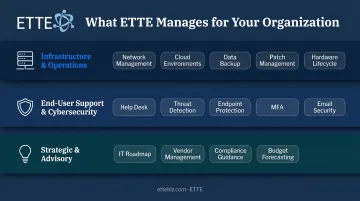
End-User Support and Cybersecurity
- Help desk and technical support (resolving daily user issues)
- Cybersecurity monitoring and threat detection
- Endpoint protection across devices
- Identity and access management, including multi-factor authentication (MFA)
- Email security and phishing defense
For organizations handling sensitive donor records, member data, or regulated client information, outsourcing cybersecurity to a dedicated provider raises the baseline of protection. Verizon's 2026 Data Breach Investigations Report found that approximately 96% of ransomware victims in its dataset were SMBs — a striking indicator of where attackers focus their attention.
Strategic and Advisory Functions
This layer is the most frequently overlooked, and for many organizations, the most consequential:
- IT roadmap planning aligned to 12–36 month organizational goals
- Vendor management and third-party risk review
- Compliance guidance for grant requirements, HIPAA, and data privacy obligations
- Technology budget forecasting and lifecycle planning
For nonprofit boards and executive directors who need clear answers about technology risk and investment, a Virtual CIO (vCIO) function fills the gap that no generalist IT staffer can. ETTE delivers this advisory layer as part of its managed IT model — converting technical findings into operational reporting that leadership can act on: what it costs, what the risk is, and what comes next.
Key Benefits of IT Operations Outsourcing
Cost Predictability and Access to Expertise
The financial case for IT outsourcing starts with one simple shift: converting unpredictable IT costs into a predictable monthly expense.
Emergency repairs carry premium rates. Unplanned contract hires are expensive and slow. Hardware failures at the wrong moment can cost far more to remediate than they would have to prevent.
A managed IT arrangement replaces that volatile spending with a stable operating line item: predictable, tied to defined service commitments, and easy to budget for.
For smaller organizations, there's an additional layer of savings that often gets underestimated: eliminating the recruitment, onboarding, training, and benefits overhead for IT roles. Consider the salary benchmarks alone:
| Role | BLS May 2024 Median Salary |
|---|---|
| Network Support Specialist | $73,340/year |
| Network & Systems Administrator | $96,800/year |
| Information Security Analyst | $124,910/year |
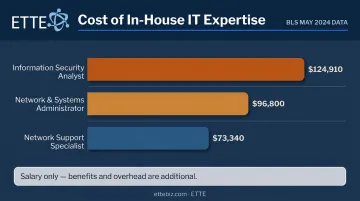
Sources: BLS Computer Support Specialists, BLS Information Security Analysts. These are salary figures only — benefits and overhead are additional.
No small nonprofit can afford a full bench of specialists across all three domains. But an MSP can, because that expertise is distributed across its entire client base.
CompTIA's IT Industry Outlook 2025 found that 37% of channel firms reported SMB customers committed to an MSP specifically to access advanced skills without hiring or retraining internally. It reflects a constraint most small organizations know well.
Improved Security Posture
Cybersecurity is where the gap between in-house and outsourced IT is most consequential — and most visible when something goes wrong.
A single internal IT generalist, however capable, cannot simultaneously manage endpoint protection, monitor security events, enforce identity controls, validate backups, and run phishing simulations. It's a structural problem, not a staffing one. NIST's CyberSeek data recorded 514,359 U.S. cybersecurity job listings between May 2024 and April 2025 — up roughly 57,000 from the prior year — reflecting just how difficult it is to source this expertise even for organizations that can afford it.
A reputable managed IT provider implements layered security as a baseline, not an add-on. That includes:
- Continuous monitoring and proactive threat detection
- MFA enforcement and identity management
- Endpoint protection and centralized patching
- Backup verification (not just backup creation)
- Structured incident response planning
- Email security configuration and phishing defense
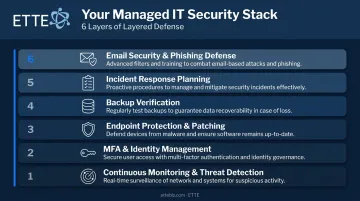
For Washington, DC organizations working with ETTE, security posture is reported through GuardRail — a board-ready security scoring system that tracks identity and access controls, configuration health, security awareness readiness, and a prioritized remediation roadmap with named owners. Leadership gets a clear picture of where the organization stands, without needing to interpret technical dashboards.
Scalability and Mission Focus
Outsourcing allows organizations to scale IT support without the lag time and cost of hiring permanent staff. During a system migration, new program launch, or grant-funded expansion, additional support capacity is available without opening a search and waiting months to onboard someone new. When that demand passes, the engagement adjusts accordingly.
This flexibility is particularly valuable for nonprofits whose operational rhythms shift with grant cycles and program cadences — NTEN's research found that only 20% of funders provided technology tools or resources in 2024, down from 23% in 2022, which means technology investment windows are narrow and unpredictable.
Every hour an executive director or operations manager spends troubleshooting IT is an hour not spent advancing organizational goals. When IT runs reliably in the background, that time returns to the work that actually matters.
Risks to Know Before Outsourcing IT Operations
Outsourcing IT solves real problems — but it introduces real risks if the arrangement is poorly structured. Here are the three worth taking seriously.
Security and Data Confidentiality Risks
Sharing system access with a third party is inherently a trust decision. If the provider lacks rigorous security protocols, that access creates exposure. Before signing anything, vet providers for:
- Documented security practices and incident response procedures
- Data handling and confidentiality policies
- Relevant compliance experience for your sector
- Contractual security terms — not just verbal assurances
CISA's joint advisory on MSP security explicitly recommends that contracts define security ownership, incident notification timelines, backup responsibilities, and account privilege management. If a provider resists codifying these terms, treat that as a signal.
Loss of Visibility and Vendor Dependency
Two risks often travel together: IT becoming a "black box" and over-reliance on a single provider.
When leadership has no meaningful way to assess what's happening with their systems, they can't make informed technology decisions. Counter this by requiring:
- Plain-language operational reporting — not technical dashboards
- Quarterly service reviews covering support trends, system health, and project progress
- Named owners on recommendations so accountability is visible
- Defined escalation paths for critical issues
Vendor dependency is a separate but related concern. Ensure contracts include clear exit provisions and that all documentation of your IT environment stays accessible to you — not held by the provider.
SLAs should spell out performance expectations in measurable terms. If the relationship ends, you need to transition without starting from scratch.
Hidden Costs and Vague SLAs
Unclear scope is where managed IT engagements go wrong most often. Before signing, confirm the contract explicitly defines:
- What is included vs. what triggers an out-of-scope billing event
- Response time commitments by issue severity
- Issue resolution targets and what happens when they're missed
- How additional requests are communicated and approved before costs are incurred
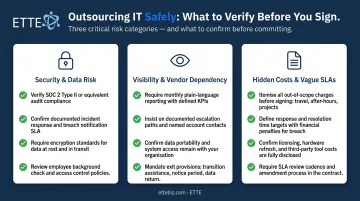
A low monthly fee can become expensive quickly when scope creep is unbounded — so push for specifics on every line item before you sign.
IT Outsourcing Models Explained
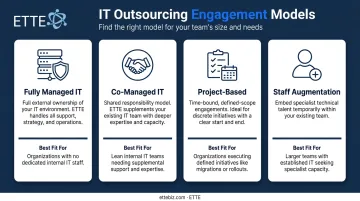
Fully Managed IT
The most comprehensive model — an external provider takes full responsibility for the organization's entire IT environment, including help desk, infrastructure, security monitoring, vendor management, and strategic advisory. It's the right fit for organizations with no dedicated internal IT staff or a very lean team.
A good fully managed IT partner operates as an embedded extension of the organization, not a remote vendor closing tickets. For small nonprofits and associations in Washington, DC, ETTE's fully managed model starts at $2,500/month and covers:
- Monitoring, patching, and help desk support (Monday–Friday, 7 AM–7 PM ET)
- Security baseline management and endpoint protection
- Environment documentation maintained from day one
- Quarterly service reviews with plain-language reporting
Co-Managed IT
Designed for organizations that have some internal IT staff but need to supplement capacity or fill skill gaps. The external provider handles specific functions — security monitoring, after-hours support, cloud management — while internal staff retain ownership of other areas.
Co-managed arrangements work well when internal bandwidth is stretched by a major initiative — a system migration, compliance program, or new program launch. ETTE's co-managed engagements start at custom scoping, so each organization defines exactly where external support adds the most value.
Project-Based Outsourcing
Engaging a provider for a defined, time-bound initiative: a cloud migration, security assessment, system implementation, or infrastructure overhaul. Project-based engagements work best alongside an ongoing managed IT arrangement, scoped to specific, time-bound deliverables rather than continuous operational coverage.
Staff Augmentation
Hiring external IT professionals to supplement an internal team on a temporary or ongoing basis. Staff augmentation suits larger organizations with established IT departments that need specialized expertise for a defined initiative. For smaller nonprofits and associations, fully managed or co-managed arrangements deliver more value per dollar.
How to Choose the Right IT Outsourcing Partner
Define Requirements Before Shopping
Start by documenting your current IT environment, key pain points, compliance obligations, and operational goals for the next 12–24 months. Then evaluate providers against those specifics.
A provider that pitches solutions before asking these questions is a red flag. The discovery process should involve the provider asking at least as many questions as they answer. Key evaluation criteria:
- Sector experience (especially with nonprofits, associations, or mission-driven organizations)
- Security credentials and documented practices
- Communication style and reporting format
- Whether they offer plain-language reporting non-technical leadership can act on
- References from organizations of similar size and complexity
Prioritize Long-Term Partnership Over Price
The cheapest option often carries the highest total cost — through low first-call resolution rates, slow escalation, vague SLAs, and weak strategic guidance. Before committing, vet each provider thoroughly:
- Ask for references from organizations of comparable size and mission
- Request sample reporting to assess clarity and usefulness
- Gauge whether they show genuine interest in your long-term success, or whether the conversation feels transactional
ETTE has built its model around long-term advisory relationships with Washington, DC nonprofits, associations, and small businesses. With 20+ years of documented, security-aware service delivery and quarterly reviews written for non-technical leadership, the focus is partnership — not just ticket volume.
Negotiate a Clear SLA and Confirm Documentation Ownership
Before signing, confirm the SLA defines:
- Response times by issue severity (P1/P2/P3 tiers)
- Escalation paths and contacts
- Included vs. excluded services with clear language
- Performance review frequency (quarterly is a strong minimum)
Equally important: confirm that IT environment documentation belongs to your organization, not the provider. Complete, current documentation — covering systems, accounts, configurations, and vendor relationships — is what protects you if the partnership ever changes.
Frequently Asked Questions
What is IT operations outsourcing?
IT operations outsourcing is the practice of contracting an external provider to manage technology functions — from help desk and infrastructure to cybersecurity and strategic IT planning — rather than relying solely on internal staff. It allows organizations to access expert support without building a full in-house IT department.
What are the types of IT operations outsourcing?
The main engagement models are fully managed IT, co-managed (hybrid), project-based, and staff augmentation. Geographically, delivery types include onshore, nearshore, and offshore — with onshore managed IT being the most common fit for DC-area nonprofits and small businesses, given regulatory alignment and the need for responsive, on-site support.
How much does it cost to outsource IT operations?
Costs vary by organization size, services included, and provider model. Fully managed IT is typically priced as a flat or per-user monthly fee — compare that against the true cost of in-house IT, including salary, benefits, training, and turnover, not just a base wage.
What IT functions are most commonly outsourced?
The most frequently outsourced functions are help desk support, network and infrastructure management, cybersecurity monitoring, data backup and recovery, patch management, and IT strategic planning and advisory.
What are the biggest risks of outsourcing IT operations?
The top risks are data security exposure, loss of operational visibility, vendor dependency, and hidden costs from vague SLAs. A provider with documented processes, transparent reporting, and a clearly scoped contract — one that specifies response times and exit provisions — addresses each of these directly.
How is IT outsourcing different from managed IT services?
Traditional IT outsourcing is often project-specific or reactive. Managed IT services is proactive and subscription-based — covering monitoring, maintenance, security, and strategic guidance on an ongoing basis, making it the more practical fit for organizations without dedicated internal IT staff.