Introduction
A Washington, DC association discovers that a staff member clicked a phishing link — and three months of member records are now in someone else's hands. A small nonprofit processes a donor payment through an unpatched system, triggering a PCI DSS violation. Neither organization thought they were a target.
That assumption is the vulnerability.
Most breaches don't happen because attackers are sophisticated. They happen because security is treated as an afterthought — something to address after a real problem emerges. For organizations without dedicated security staff, that reactive posture is especially dangerous.
Nonprofits, associations, and small businesses hold genuinely valuable data: donor payment details, member PII, health records, financial files. Attackers know this.
A structured approach to information security management (ISM) doesn't require a full-time security team or enterprise-level budget. It requires discipline, the right framework, and consistent execution.
This article covers:
- What ISM actually means and how it's defined
- Its core components and how they work together
- Why it matters specifically to smaller organizations
- Which frameworks apply at different maturity levels
- Best practices that make a measurable difference
Key Takeaways
- ISM is the discipline of identifying, assessing, and managing controls to protect organizational information — covering confidentiality, integrity, and availability.
- An ISMS is the formal, documented framework that puts ISM into practice across people, processes, and technology.
- Nonprofits and associations are frequent attack targets — they hold sensitive donor, member, and financial data but often operate with limited security defenses.
- Effective ISM rests on five pillars: risk assessment, security policies, access and technical controls, employee training, and continuous monitoring.
- NIST CSF 2.0 and ISO/IEC 27001:2022 are the most practical starting frameworks for nonprofits, associations, and small businesses building their security program.
What Is Information Security Management?
Information security management is the organizational discipline of identifying what information assets need protection, understanding the risks to those assets, and putting the right controls in place — keeping data confidential, accurate, and accessible to authorized users while keeping it away from everyone else.
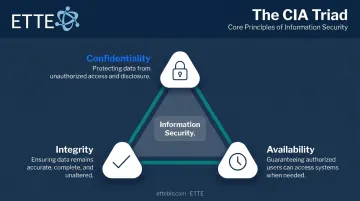
Three foundational properties define what "protection" actually means:
- Confidentiality — Only authorized people can access the information
- Integrity — Data is accurate and free from unauthorized changes
- Availability — Authorized users can access data when they need it
Together, these form the CIA Triad, which underpins every ISM framework in use today. NIST's FIPS 199 formally defines all three properties, while also recognizing authenticity and non-repudiation as closely related concepts — placed within the integrity category rather than treated as separate pillars.
ISM vs. IT Security vs. Cybersecurity
These terms are often used interchangeably, but they mean different things:
| Term | Scope |
|---|---|
| Cybersecurity | Defending digital systems and networks from online threats |
| IT security | Protecting technology assets broadly |
| Information security | Protecting data in all forms — physical and digital |
| Information security management | The management discipline that governs all of the above |
ISM is the coordinating layer. It doesn't replace IT security or cybersecurity. It gives each discipline a clear owner, defined scope, and a governing framework.
Introducing the ISMS
An Information Security Management System (ISMS) is the formal, documented implementation of ISM. It's a management framework — policies, procedures, and controls that collectively govern how an organization protects its information. No single product delivers this; it has to be built and maintained deliberately.
In large organizations, a Chief Information Security Officer (CISO) owns this function. In smaller nonprofits and associations, ISM responsibility typically falls to an IT manager, operations lead, or an outsourced IT partner. Either way, ISM needs visible leadership support to succeed — board and executive buy-in determines whether security policies get funded, followed, and enforced.
Core Components of an Effective ISM Program
Risk Assessment and Management
Risk assessment is where every ISM program starts. Before buying tools or writing policies, an organization needs to know:
- What information assets do we hold? (donor records, member PII, financial files, health data)
- What threats and vulnerabilities face those assets?
- Which risks are most urgent given our resources and tolerance?
The goal isn't to eliminate all risk — that's not achievable. It's to bring risk to an acceptable level based on what the organization can realistically manage.
Security Policies and Governance
Security policies are the documented rules that tell staff how to handle information, who can access which systems, and what to do when something goes wrong. Without them, controls become inconsistent and unenforceable.
Core policies every organization should have:
- Acceptable use policy
- Data classification policy
- Password and authentication policy
- Incident response plan
- Vendor management policy
- Employee onboarding and offboarding procedures
ETTE's approach with Washington, DC nonprofits and associations begins here — establishing clear ownership for policies and ensuring they're current, approved, and actually findable, not buried in a shared drive no one visits.
Security Controls
ISM layers three categories of controls, not just technology:
Technical controls:
- Multi-factor authentication (MFA)
- Endpoint protection and managed detection/response
- Email security and anti-phishing filtering
- Encryption and web filtering
- Access management and conditional access policies
- Backup and recovery systems
Physical controls:
- Locked server rooms and secure workstation setups
- Visitor access logs
- Device management for remote and hybrid teams
Procedural/Administrative controls:
- Background checks and onboarding security training
- Change management workflows
- Vendor vetting and third-party risk assessment
A "firewall and antivirus" approach leaves significant gaps. Layering all three categories (what's often called defense in depth) means that if one control fails, others remain in place.
Employee Training and Security Awareness
The 2026 Verizon Data Breach Investigations Report finds a human element present in 62% of breaches, with social engineering and phishing each appearing in 16% of incidents. These numbers reflect a consistent pattern: people are a primary attack surface, and training is one of the most direct ways to reduce exposure.
A 2024 peer-reviewed review of 42 studies on phishing training found that even after training, approximately 23% of users remain susceptible — meaning training reduces risk substantially but doesn't eliminate it. The same review found embedded training delivered a mean detection improvement of 25%, outperforming passive e-learning formats.
What an effective security awareness program looks like in practice:
- Regular refresher training (not just annual compliance check-boxes)
- Simulated phishing exercises with feedback
- Clear procedures for reporting suspicious activity
- Role-specific training for staff who handle sensitive data
Monitoring, Incident Response, and Continuous Improvement
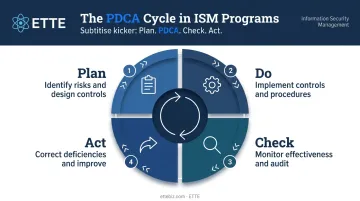
Training reduces exposure, but it doesn't replace ongoing oversight. Threats evolve, staff change, and systems drift from their secure configurations — so ISM programs need a repeating cycle, not a one-time setup. The Plan-Do-Check-Act (PDCA) framework structures that cycle:
- Plan — Identify risks, set objectives, design controls
- Do — Implement controls and procedures
- Check — Monitor effectiveness, audit controls, review incidents
- Act — Correct deficiencies and improve based on what you learn
A documented incident response plan is non-negotiable. Staff need to know exactly what to do when a security event occurs, not figure it out in the moment.
ETTE treats recovery readiness as equally important as prevention. Reliable backups, tested procedures, and a clear response plan determine whether an incident becomes a difficult afternoon or a weeks-long operational disruption.
Why Information Security Management Matters for Small Organizations
The Target Misconception
Small organizations frequently assume they're not worth a sophisticated attacker's time. This is wrong, and attackers know it. Nonprofits and associations hold donor payment information, member PII, health or financial records — and typically run with fewer defenses than larger institutions.
The IBM 2025 Cost of a Data Breach Report puts the global average breach cost at $4.4 million, a figure that reflects all organization sizes. Even a fraction of that cost can be catastrophic for a 30-person association operating on grant funding.
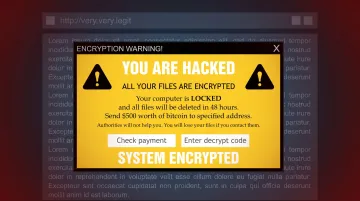
Ransomware is a particular threat. The 2025 Verizon DBIR reports ransomware appears in 44% of all breaches. The American Radio Relay League, a US nonprofit association, paid a $1 million ransom following a May 2024 attack — a stark illustration that associations are not exempt from serious incidents.
The Compliance Dimension
Depending on what data an organization handles, regulatory requirements may already apply:
- HIPAA — Any organization that touches protected health information
- PCI DSS v4.0.1 — Every entity that stores, processes, or transmits payment card data, regardless of size
- State laws — DC, Maryland, and Virginia each impose data security and breach notification obligations with different thresholds and timelines
A well-run ISM program makes compliance a byproduct of good security practice rather than a separate burden. These frameworks overlap significantly, meaning controls built for one often satisfy multiple requirements simultaneously.
ISM as Mission Protection
For nonprofits and associations, a data breach or extended system outage isn't just a financial problem. It disrupts service delivery, erodes donor and member trust, and can threaten long-term viability. Framed correctly, ISM is mission protection.
Boards are increasingly expected to oversee cybersecurity risk alongside financial and programmatic risk. ETTE's GuardRail framework is built for this responsibility. It translates technical security status into plain language that leadership can act on, covering:
- Identity and access posture
- Configuration and controls
- Training completion rates
- A prioritized remediation roadmap with named owners and target dates
Leadership gets the visibility needed to fulfill governance responsibilities without requiring technical expertise.
Common ISM Frameworks and Standards
ISM frameworks are pre-built blueprints. Rather than designing a program from scratch, organizations align with a recognized framework that provides a structured set of requirements and controls. No single framework is mandatory for all organizations — the right choice depends on industry, size, and regulatory context.
The Two Most Relevant Frameworks
ISO/IEC 27001:2022 is the internationally recognized standard for an ISMS, published in October 2022 (now the current third edition, with Amendment 1 published in 2024). It specifies auditable requirements and enables independent certification. ISO 27001 becomes relevant when enterprise partners, funders, or government contracts require a certified ISMS.
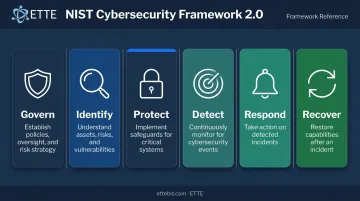
Released February 26, 2024, NIST Cybersecurity Framework 2.0 organizes security around six functions: Govern, Identify, Protect, Detect, Respond, and Recover. NIST SP 1300, also published in February 2024, is a CSF 2.0 Quick-Start Guide built for small businesses, nonprofits, schools, and small government agencies. For most of ETTE's clients, it's the most accessible starting point.
ETTE structures its GuardRail controls around CIS Controls and NIST-style control categories, allowing clients to use the same reporting to respond to auditors, insurers, and funders. This is practical alignment, not formal certification — a distinction worth understanding before any audit conversation.
Industry-Specific Frameworks
| Framework | Applies to |
|---|---|
| HIPAA Security Rule | Covered entities and business associates handling electronic PHI |
| PCI DSS v4.0.1 | All entities affecting cardholder data environments |
| CMMC | DoD contractors handling Federal Contract Information or CUI |
These frameworks overlap with NIST CSF and ISO 27001. HHS provides a crosswalk between HIPAA Security Rule provisions and NIST CSF outcomes, but explicitly notes that CSF use does not guarantee HIPAA compliance — these are parallel, not interchangeable.
Information Security Management Best Practices
Start with a Risk Assessment
Before purchasing tools, run a risk assessment. Many small organizations buy security software reactively — antivirus here, a VPN there — without understanding which assets actually need the most protection. A documented risk assessment clarifies priorities and ensures budget addresses real risks, not assumed ones.
Build Defense in Depth
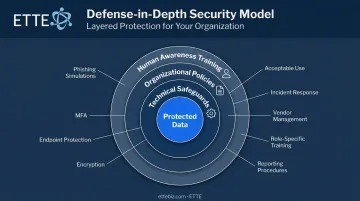
No single control is sufficient. Effective ISM combines:
- Technical safeguards — MFA, endpoint protection, encryption, email security
- Organizational policies — Acceptable use, incident response, vendor management
- Human awareness training — Ongoing, role-specific, with simulated exercises
If one layer fails, others hold. This is the core argument against the "firewall and antivirus" mentality that still dominates thinking in many small organizations.
Build Security Culture Intentionally
Security culture doesn't emerge on its own. It requires recurring training, clear reporting procedures, and visible leadership commitment. When the executive director takes a phishing simulation seriously, staff follow. Staff disengage just as quickly when security is framed as an IT concern rather than an organizational responsibility.
For resource-limited organizations, consistent awareness efforts — even lightweight ones — reduce risk exposure. A few practical culture-building habits make a measurable difference:
- Schedule brief, recurring security reminders (monthly emails, quarterly training)
- Establish a clear, low-friction process for reporting suspicious activity
- Have leadership visibly participate in phishing simulations and training
ETTE has embedded these practices into managed IT delivery for Washington, DC nonprofits and associations since 2002, treating security awareness as a baseline component of IT service — not an optional upgrade.
Frequently Asked Questions
What is information security management?
Information security management is the discipline of protecting an organization's information assets — covering confidentiality, integrity, and availability — through policies, technology, and organizational controls. It serves as the governance layer that coordinates IT security, cybersecurity, and physical data protection under a single managed framework.
What are the key components of an ISMS?
The core components are: risk assessment and treatment, documented security policies, technical and physical controls, employee training and awareness programs, and ongoing monitoring with incident response procedures. Together, these address the people, processes, and technology dimensions every ISMS must cover.
What is the difference between information security and cybersecurity?
Cybersecurity focuses specifically on defending digital systems and networks from online threats. Information security is broader — it covers protecting data in all forms, physical and digital, through policies, controls, and management practices. ISM provides the governance structure that brings both under a coordinated program.
Do nonprofits and small associations really need information security management?
Yes. Smaller organizations are frequently targeted because they hold sensitive donor, member, or client data but often have weaker defenses than larger institutions. ISM scales to fit any organization's size, resources, and risk profile — and for smaller organizations, that scalability is exactly what makes it practical.
What framework should a small organization use to get started?
For most US-based small organizations, the NIST Cybersecurity Framework 2.0 is the most accessible starting point — its plain-language structure and dedicated SMB quick-start guide (NIST SP 1300) make it practical without requiring extensive security expertise. ISO 27001 becomes relevant when partners, funders, or regulators specifically require a certified ISMS.